Knowing how to spot a fake Rolex has become a genuine skill set — one that secondhand buyers, watch enthusiasts, and replica collectors all pursue for very different reasons. Whether you are trying to avoid being misled at a grey-market price or you simply want to understand what separates a mass-produced knockoff from a precision-engineered 1:1 mirror-grade piece, the details matter enormously. Rolex manufactures to some of the tightest tolerances in the industry, and those tolerances leave a clear fingerprint across every component of the watch. This guide breaks down each zone of the watch systematically so you can form an informed opinion with your own eyes.
The Dial: Where Most Fakes Fail First
The dial is the most scrutinized surface on any Rolex, and for good reason. Genuine Rolex dials are produced in-house at their Chene-Bourg facility and subjected to extraordinary quality control. The printing is applied in multiple laser-precise layers, creating a slightly raised, three-dimensional texture that you can feel with a fingernail dragged lightly across the text.
Text Alignment and Font Weight
On a genuine Submariner Date (ref. 126610LN) or a GMT-Master II (ref. 126710BLNR), every character of "ROLEX", "OYSTER PERPETUAL", and the model name sits on a perfectly consistent baseline. The crown logo above the brand name is applied separately and shows crisp micro-detail under 10x loupe magnification. On lower-quality counterfeits the font weight is visibly inconsistent, the crown logo bleeds or shows jagged edges, and the text baseline drifts. High-quality 1:1 replicas, by contrast, use the correct typeface weights and multi-layer dial printing that passes casual and even moderate inspection.
Lume Plots and Hour Markers
Genuine Rolex hour markers on the Submariner and Sea-Dweller are applied Chromalight lume capsules — a deep-blue glowing compound sealed inside polished white-gold or platinum surrounds. Cheap fakes use flat painted lume that looks yellowed under normal light and emits a weak green glow rather than the blue Chromalight signature. The surrounds on poor replicas are also visibly irregular; on the genuine article and on quality 1:1 pieces each capsule is geometrically identical to the next.
The Movement: The Heart of the Debate
Rolex manufactures every movement in-house. The calibre 3235 found in the current Datejust 41 and Submariner Date, the 3285 in the GMT-Master II, and the 9001 in the Sky-Dweller are COSC-certified chronometers that Rolex then rates to their own tighter standard of -2/+2 seconds per day. Opening the caseback of a watch is the fastest way to identify what you have.
- Sweep seconds hand: genuine Rolex movements beat at 28,800 vph (8 beats per second), producing a fluid near-continuous sweep. A ticking hand that moves in 1-second jumps indicates a cheap quartz movement — an immediate disqualifier on any claimed genuine Rolex.
- Rotor finish: the genuine cal. 3235 rotor carries a bidirectional Perpetual rotor in tungsten with a fine striping finish and the Rolex crown engraved at its center. Imitation rotors often show rough edges, incorrect engravings, or a lightweight feel from aluminium substitution.
- Plate decoration: authentic Rolexes use Cotes de Geneve striping on certain bridges and perlage (circular graining) on the base plate. Cheap movements skip these finishing steps entirely.
- Serial number location: since 2008 Rolex engraves the serial between the lugs at the 6 o'clock side, not on the caseback. A serial engraved on the caseback suggests a pre-2008 reference or a fake trying to avoid the lug engraving process.
- Halting on the seconds: a genuine Rolex equipped with the Parachrom hairspring and Paraflex shock absorbers resists magnetic disturbance. If a watch's seconds hand stutters near metal surfaces, the movement inside is not a genuine Rolex calibre.
Case Finishing: Polished vs Brushed Surfaces
Rolex cases are machined from a single block of Oystersteel (their proprietary 904L stainless steel) or 18k gold alloys produced in their own foundry. The case on a Submariner presents a deliberate mix of brushed flanks on the lugs and a high-polished bezel edge and middle case. That transition between finish types is razor-precise on a genuine example. On a low-quality fake the brushed areas show circular swirl marks from rotary polishing rather than straight-line satin brushing, and the polished sections carry micro-scratches that betray soft, low-grade steel. Our specialist workshops apply the same 904L steel and the same directional brushing methodology — you can see the difference immediately against a budget counterfeit.
Crown and Gasket System
The Rolex Triplock winding crown on a Submariner or Sea-Dweller carries three dots on its side face and screws down firmly with a positive, progressive resistance. Cheap copies use crowns that are either stamped with a vague Rolex crown logo or have crowns that cross-thread or fail to achieve a torque-positive lock. The Twinlock system found on Datejust and Day-Date models shows two dots. Any crown without the correct dot count for the reference in question is wrong.
Bracelet and Clasp: Tolerances Tell the Story
Rolex bracelets — the Oyster, Jubilee, and President — are assembled to sub-millimetre tolerances. On the current five-piece Oyster bracelet of the Submariner the links feel solid, rattle-free and uniform. The Oysterlock clasp on the Submariner and the Crownclasp on the Sea-Dweller both incorporate the Glidelock extension system, allowing 2mm incremental adjustments via an internal ratchet. If the Glidelock ratchet is sloppy, misses positions, or is absent entirely, the bracelet is not genuine.
- Link tolerances: genuine Oyster and Jubilee links have zero lateral play when new. Hold the bracelet in both hands and flex it sideways — any slop points to loose riveting or inferior casting.
- Clasp engravings: the Oysterlock clasp is engraved with the Rolex crown and the reference number of the bracelet/clasp system on the inner face. Cheap fakes omit the reference or render the crown indistinctly.
- Endlink fit: the endlinks that mate the bracelet to the case should sit flush with zero visible gap. A visible step or gap between endlink and lug indicates a bracelet produced for a slightly different case width.
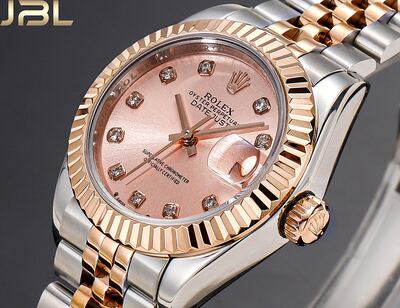
- Jubilee bracelet (Datejust 41, ref. 126300): the five-piece link structure on the current Jubilee is entirely solid-link construction. Earlier replica Jubilees used hollow centre links that produced a tell-tale metallic rattle.
- Fliplock vs Oysterlock: the Datejust and Day-Date use the Fliplock butterfly clasp. A genuine Fliplock unfolds symmetrically and closes with an audible, crisp snap. Imitations often have asymmetric fold-out tabs and a soft, dull close.
Bezel and Crystal: Details Under Magnification
The Submariner ceramic bezel insert (Cerachrom) is produced from zirconium oxide ceramic in a proprietary process that renders the colour indelible and scratch-proof to anything short of diamond. The pip at 12 o'clock is a platinum coating applied inside the ceramic, not painted on top. On poor fakes the pip is painted gold or silver and lifts at the edges under a loupe. The Datejust cyclops lens is a genuine magnifier that enlarges the date exactly 2.5x — hold the watch level and look at the date straight on. A cyclops that fails to achieve clean 2.5x magnification, or that shows prismatic colour fringing, is not a genuine Rolex sapphire crystal. Our quality assurance process specifically checks cyclops magnification and Cerachrom pip adhesion on every watch before dispatch.
Frequently Asked Questions
Does a genuine Rolex tick or sweep? A genuine Rolex always sweeps. The in-house mechanical movements beat at 28,800 vibrations per hour, making the seconds hand appear to glide. Rolex has never produced a quartz wristwatch for the consumer market since discontinuing the quartz Oysterquartz line in 2001, so any current-production Rolex that ticks in one-second intervals is either a quartz fake or a heavily modified watch.
Can you tell a fake Rolex by weight? Weight is a useful but not definitive check. A genuine Submariner 126610LN weighs approximately 155g on its Oyster bracelet because of the solid 904L Oystersteel and tungsten rotor. Cheap counterfeits made from 316L steel or zinc alloys will feel noticeably lighter. However, high-quality 1:1 replicas — like those available in our replica watches collection — use the correct steel grade and tungsten rotors, so weight alone cannot distinguish quality tiers from one another.
Is it illegal to buy a replica watch for personal use? Laws differ by jurisdiction and the context of use. In most countries purchasing a replica for personal use and not for resale sits in a legal grey area. The issues typically arise at the point of commercial sale with brand-impersonating intent. If you are buying a 1:1 replica openly described as such — as every piece on UADEPOT is — you are making an informed choice about an openly marketed reproduction, not purchasing something falsely sold as authentic.
Shop Mirror-Grade Replica Watches at UADEPOT
If you want to understand what the best 1:1 Rolex replicas look and feel like — pieces built with 904L Oystersteel cases, Chromalight lume, ceramic Cerachrom bezels and automatic movements — browse our full replica watches store. Every reference is photographed against genuine examples during our quality assurance checks, and we ship worldwide at no additional cost. We also carry mirror-grade designer bags and accessories for the same collector standard across every category. When you know exactly what separates a quality 1:1 from a cheap knockoff, you shop with confidence — and that is precisely the standard our specialist workshops hold themselves to.